
When Dr. Vishnu and Dr. Neema decided to open Hear Again Clinics in Bangalore, they faced the same challenge every healthcare entrepreneur encounters: how do you build a digital presence that actually brings patients through your door?
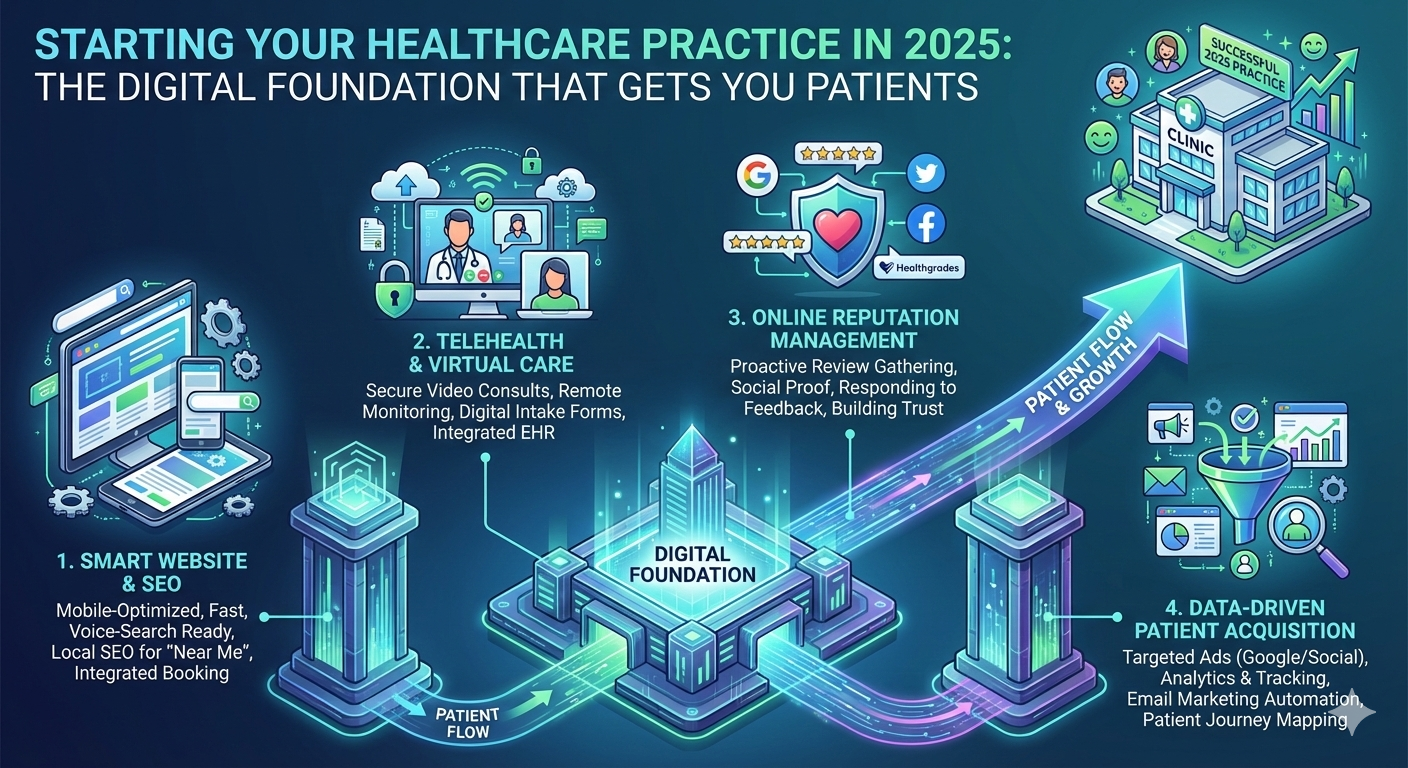
They weren’t just audiologists anymore. They were business owners who needed to be found online, trusted immediately, and chosen over established competitors. Three years later, with seven locations across Bangalore and thousands of patients served, they’ve learned lessons that every healthcare professional starting their own practice needs to know.
The Three-Month Window That Makes or Breaks New Practices
Here’s what nobody tells you about starting a healthcare business: you have roughly three months before your savings start making you nervous. Those first 90 days determine whether you’ll build momentum or burn through capital while waiting for patients who never come.
The difference between practices that thrive and those that struggle? It’s not clinical expertise – you already have that. It’s not fancy equipment or prime location either. It’s whether you nail these digital fundamentals before you open your doors.
Most healthcare entrepreneurs make the same mistake: they focus entirely on clinical setup (equipment, licensing, staff) and treat digital presence as an afterthought. They launch with a basic Facebook page, maybe a website thrown together in a week, and wonder why the phone isn’t ringing.
Your Brand Name: The Decision That Echoes for Decades
Before you sign any lease or order equipment, you need a name that works. Not just something that sounds medical and professional – that’s table stakes. You need a name that patients remember after seeing just one ad, that sounds trustworthy when their family asks “who did you see?”, and that won’t limit you when you expand services in year three.
When starting a healthcare practice, most founders fall into predictable traps: names so generic they’re invisible (City Medical Center), names so clinical they sound cold (Audiology Associates), or names so cute they undermine credibility (Happy Ears). The sweet spot is memorable, warm, and professional.
But here’s the harder part: your perfect name might already belong to a clinic two neighborhoods over. Or a dental practice in Delhi. Or a physiotherapy center using a similar variation. This is where healthcare businesses run into trademark nightmares – six months after printing letterheads and building reputation, they discover they can’t legally protect their brand.
The smart approach? Generate multiple strong options quickly, then validate them before you fall in love. AI name generators have revolutionized this step, letting you explore hundreds of directions in an afternoon instead of weeks of brainstorming meetings. Then, before you commit, check how many businesses use similar names – this saves you from the heartbreak of rebranding later.
The Website That Works While You Sleep
Your website isn’t a digital brochure. It’s your hardest-working employee, answering patient questions at 11 PM, building trust with nervous first-timers, and converting researchers into appointments.
Most healthcare websites fail because they’re built backwards. They list services, credentials, and equipment – all important, but all wrong as the opening message. Patients don’t care about your BERA testing capabilities until they trust you’ll handle their father with dignity. They don’t care about your partnership with premium hearing aid brands until they believe you’ll recommend what they need, not what’s most profitable.
Your homepage needs to do three things in seven seconds:
- Show them you understand their specific fear (not generic “hearing problems” but “missing your grandchild’s first words”)
- Demonstrate you’ve helped people exactly like them
- Make the next step ridiculously easy
Here’s what actually converts: patient stories with specific details. Not “Mr. Kumar regained his hearing” but “Mr. Kumar heard his daughter’s wedding vows – after missing his son’s ceremony five years ago.” Not stock photos of smiling seniors, but actual patients (with permission) showing real emotion.
But even the best website is useless if Google can’t find it. This is where new practices hemorrhage opportunity – they launch beautiful sites that might as well be invisible because they skipped basic technical SEO setup.
The SEO Checklist You Can’t Skip
Technical SEO sounds intimidating, but it’s really just a checklist. The problem is most healthcare entrepreneurs either ignore it completely or pay agencies ₹50,000 for work they could do themselves in an afternoon.
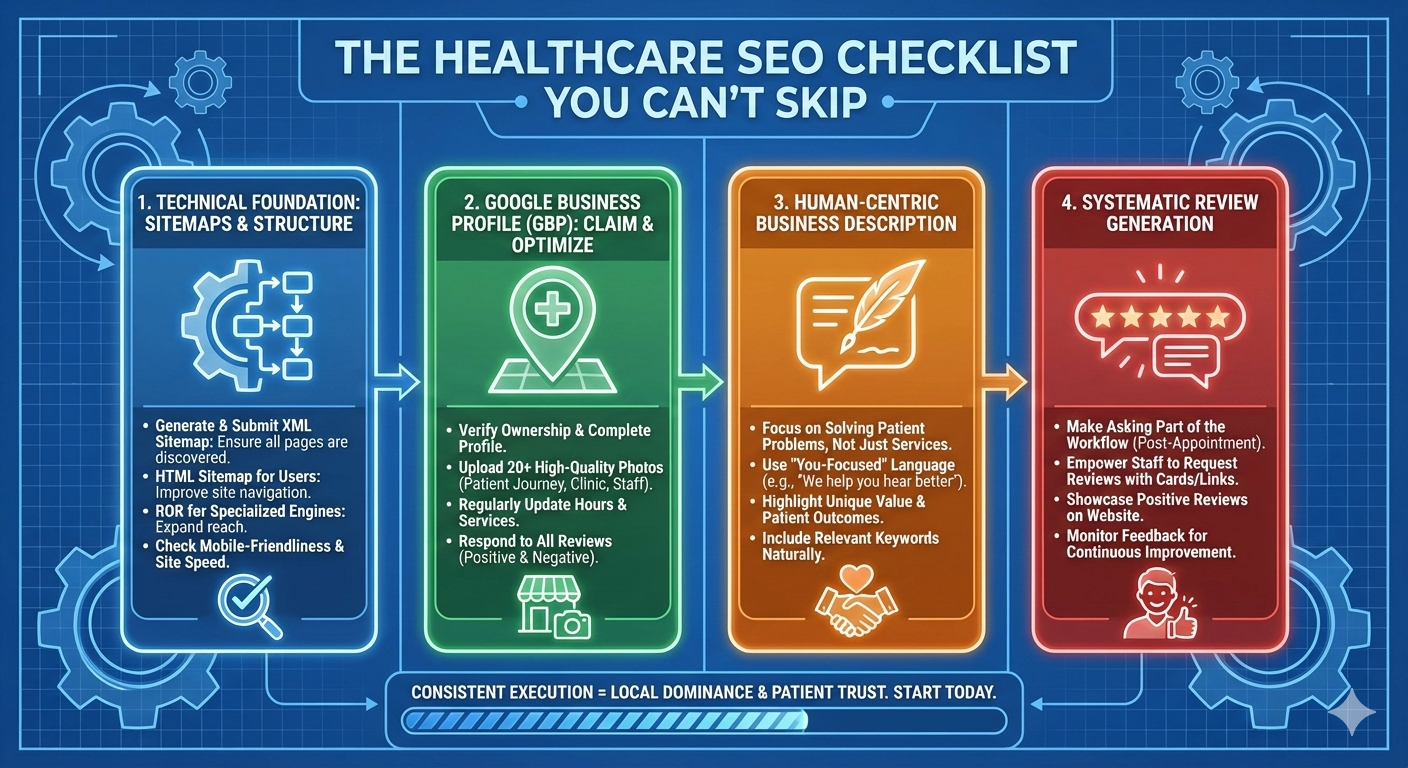
Start with sitemaps – the file that tells Google every page on your site and how they connect. Without this, search engines might miss half your content. Tools exist that generate these files in multiple formats (XML for Google, HTML for users, ROR for specialized engines), but most practice owners don’t even know they’re necessary until months after launch.
Next, claim your Google Business Profile properly. Not just “fill it out” – optimize it. Most clinics upload three random photos and call it done. The ones that dominate local search upload 20+ photos showing the patient journey: welcoming reception, clean testing rooms, friendly staff, happy patients (again, with permission).
Write your business description for humans having specific problems, not SEO robots. “We provide comprehensive audiological services” loses to “If you’re missing conversations with family, we’ll figure out why – usually in one visit.”
Get reviews systematically from day one. Not by begging, but by making it part of your workflow. After a great appointment, while the patient is still in their success moment, have your receptionist say: “We’d love if you’d share your experience – it helps other people like you find us.” Then hand them a card with simple instructions.
The Content Strategy That Builds Trust Before First Contact
Here’s the counterintuitive truth about healthcare marketing: the best patients aren’t searching for “hearing aids near me” or “audiologist Bangalore.” Those people are ready to buy and will price-shop you to death.
The best patients are searching for answers six months before they’re ready to book. They’re Googling “why do I keep asking people to repeat themselves” and “is 35 too young for hearing loss” and “how to know if my father’s memory problems are actually hearing problems.”
If you answer those questions comprehensively, you become the trusted authority before they even know they need you. Then, when they’re finally ready to act, you’re not competing – you’re the obvious choice.
This means creating 20-30 blog posts before you launch. Not promotional posts (“10 reasons to choose our clinic”) but genuinely helpful content that ranks and builds trust. Each post should target a specific anxiety or question, include real examples from your experience, and assume the reader might never become a patient – but deserves good information anyway.
Yes, this is work. Yes, it takes time or money. But consider the math: one well-ranking blog post that brings five qualified patients per month for three years is worth 180 patients. At an average lifetime value of ₹50,000 per patient, that’s ₹90 lakhs in revenue from one blog post.
Your Local Presence: The Channels Nobody Talks About
Every healthcare business guide tells you to be on Facebook and Instagram. They’re right, but they’re also missing the actual goldmines for local practices.
Google Maps optimization beats social media 10:1 for local healthcare. When someone searches “hearing test near me,” the map results get clicked before the organic results. Your map listing needs to be immaculate: accurate hours, current photos, active Q&A section, regular posts.
WhatsApp Business is criminally underutilized by healthcare practices. Patients, especially in India, prefer WhatsApp for appointment booking and questions. Set up a proper business account with auto-replies, appointment confirmation messages, and quick replies for common questions. This alone will save your receptionist 2 hours daily.
Local partnerships matter more than you’d expect. Connect with ENT doctors who see patients before they need audiology. Partner with senior living communities for regular screening camps. Collaborate with corporates for employee wellness programs. These channels bring pre-qualified, high-trust referrals.
The Mistake That Kills Most Healthcare Startups
Want to know the real reason most new practices struggle? They wait until everything is perfect before they start marketing. They wait for the website to be flawless, the blog to have 50 posts, the staff to be fully trained, the systems to be seamlessly optimized.
Meanwhile, the clinic that launched with “good enough” and started telling their story immediately has 200 patients and recurring revenue.
Perfect is the enemy of opened. Launch your digital presence when it’s 80% ready, then improve it based on real patient feedback, not imaginary concerns. Your first website doesn’t need video testimonials and 30 blog posts – it needs your story, your credentials, your contact information, and one clear path to booking an appointment.
Start creating content now, before you have a location. Start building your Google presence before you have a reception desk. Start answering questions in local Facebook groups before you have patients to talk about.
The 30-Day Launch Sequence That Works
Here’s the practical timeline that healthcare entrepreneurs should follow:
Days 1-7: Brand Foundation
- Finalize business name (generate options, validate uniqueness)
- Register domain and social handles
- Design basic logo and color scheme
- Write your founding story
Days 8-14: Website Launch
- Set up website with essential pages (home, about, services, contact)
- Add booking system or clear contact method
- Generate and submit sitemap
- Optimize for mobile (60% of healthcare searches are mobile)
Days 15-21: Content Creation
- Write 10 blog posts answering common patient questions
- Create 5 patient journey stories (can be hypothetical initially)
- Film 3 short videos explaining your approach
- Prepare social media content calendar for first month
Days 22-30: Local Presence
- Set up and optimize Google Business Profile
- Claim listings on Practo, Justdial, and relevant directories
- Join 10 local Facebook groups where your patients hang out
- Start conversation in healthcare forums (provide value, no selling)
This sequence means when you open your doors, you’re not starting from zero. You have digital infrastructure that’s already working, content that’s already ranking, and presence where your patients already are.
The Long Game: What Success Actually Looks Like
Three years after launching, Hear Again Clinics operates seven locations and has helped thousands of patients. But what’s more impressive is how they built it: through systematic digital presence that compounds over time.
Their early blog posts still bring patients. Their Google reviews from year one still convince hesitant prospects. Their investment in proper naming, SEO setup, and consistent content creation paid dividends for years, not just months.
That’s the healthcare entrepreneur’s advantage: you’re building an asset, not just running ads. Every patient story shared, every question answered comprehensively, every technical SEO element done right – they all accumulate value.
The practices that struggle are the ones that treat digital marketing as a campaign with a start and end date. The practices that thrive treat it as infrastructure – like your clinical equipment or your facility lease. You build it once properly, maintain it consistently, and it supports your growth for years.
Start Now, Improve Forever
You don’t need everything perfect to start. You don’t need a ₹5 lakh website or a full-time marketing person or 100 blog posts. You need the fundamentals done right: a memorable name you can protect, a website that builds trust, technical SEO that makes you findable, and content that positions you as the obvious choice.
Then you open your doors, see real patients, gather real stories, and improve everything based on reality instead of guesswork.
The healthcare practice of your dreams doesn’t start with the perfect location or the newest equipment. It starts with digital foundations that let patients find you, trust you, and choose you – starting on day one.
Your future patients are searching for answers right now. The question is whether they’ll find you or your competitor who got their digital presence right.
Conclusion
Building a successful healthcare practice today is no longer just about clinical excellence—it’s about being visible, trustworthy, and accessible long before a patient ever walks through your door. The story of Hear Again Clinics makes one thing clear: digital foundations aren’t marketing extras, they’re survival tools. From choosing a name you can grow with, to launching a website that speaks to real fears, to showing up consistently where patients are already searching, every small decision compounds over time.
What separates clinics that struggle from those that scale isn’t perfection—it’s momentum. The practices that win are the ones that start early, tell their story honestly, and improve in public. They treat their digital presence like infrastructure, not a campaign, knowing that every blog post, review, and optimized listing quietly builds trust while they sleep.
If there’s one takeaway, it’s this: start now. Launch before you feel ready. Let real patients shape your message. Do the fundamentals well, stay consistent, and keep improving. In healthcare, trust is everything—and trust today is built online, one helpful answer and one genuine story at a time.